Technology

Our modern societies need effective solutions to address urgent global challenges such as deteriorated human health and climate change. Advanced materials, particularly those that take advantage of the unique properties of matter in the nanoscale, are crucial for developing disruptive technologies such as sensors, catalysts, batteries, fuel cells and medicine. A key component of such advanced materials are the nanoparticle building blocks that they often consist of, attributing unique properties and unique possibilities.

Nanoparticle Generator

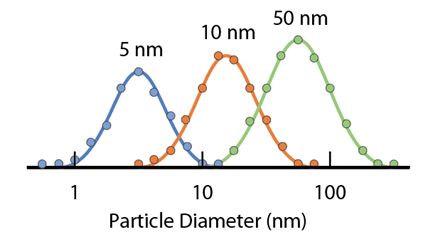
We have developed an innovative nanoparticle synthesis device that can address long-standing challenges in nanofabrication. The technology uses inductive heating to evaporate a wide range of materials, in the form of electrodes, and condenses the resulting vapours to produce highly pure nanoparticles that range from ca. 1 to 100 nm in size (see distributions below). The generated nanoparticles can be collected as powders for further use, or deposited directly on advanced materials depending on the application.

Being a one-step process, the inductive heating nanoparticle generator of Nanomicron offers simplicity and high versatility, making it extremely advantageous compared to traditional wet-chemistry processes that require several steps. Using carrier gases at atmospheric pressure, the technology is cost-effective and easy to operate, while it is environmentally friendly as it does not produce any wastes.

Sensors

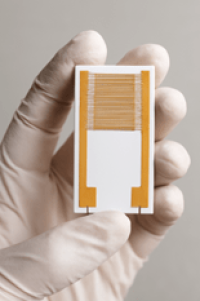
Using nanoparticles produced by our inductive heating generator (or other similar evaporation-condensation methods), we produce a range of metal oxide sensors for detecting trace gases in ambient air. Coupling the generators to systems that can deposit the aerosol nanoparticles directly onto substrates (specifically on interdigitated electrodes; see image on the right) by inertial and/or electrostatic forces, we can produce a range of nanoparticulate-based materials that can be used as very sensitive sensing elements. Examples of sensors we develop include but are not limited to nitrogen dioxide and methane, which comprise important air pollutants.

© 2025 Nanomicron Ltd. All rights reserved.